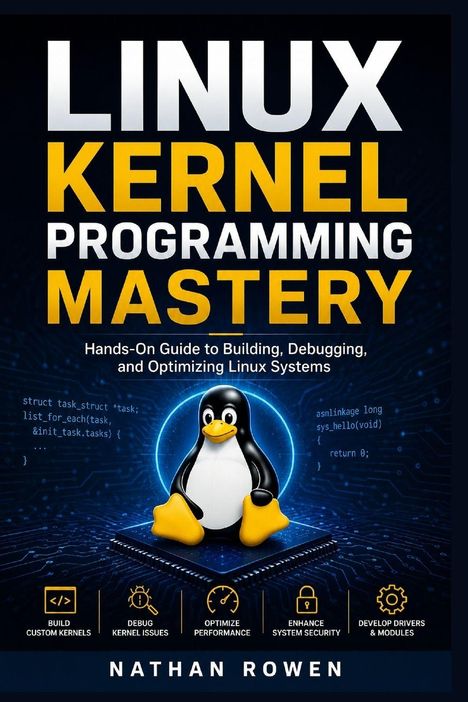

Nathan Rowen: Linux Kernel Programming Mastery, Kartoniert / Broschiert
Linux Kernel Programming Mastery
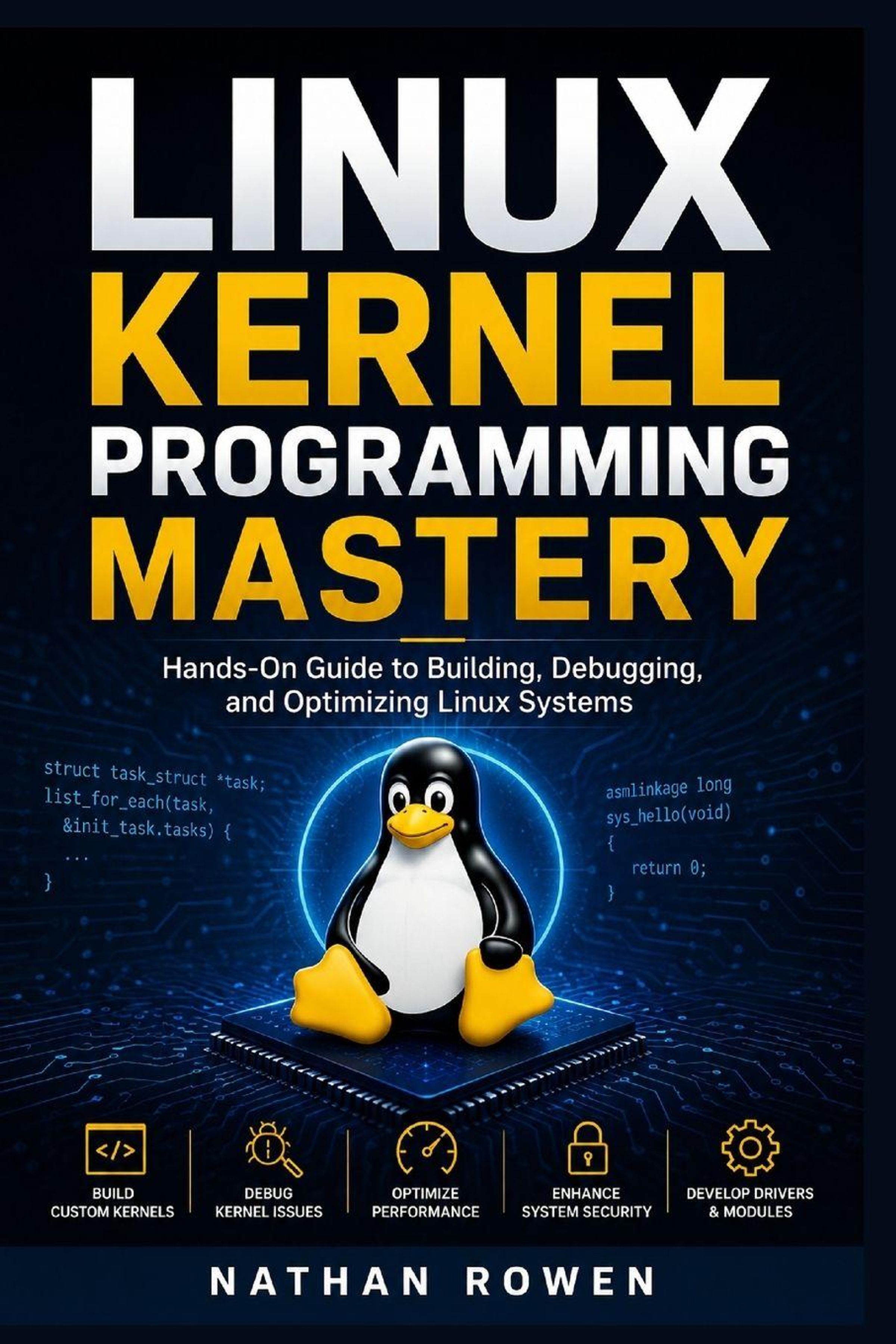
(soweit verfügbar beim Lieferanten)
- Verlag:
- Nathan Rowen, 10/2026
- Einband:
- Kartoniert / Broschiert
- Sprache:
- Englisch
- ISBN-13:
- 9783116500466
- Artikelnummer:
- 12971403
- Umfang:
- 138 Seiten
- Gewicht:
- 212 g
- Maße:
- 229 x 152 mm
- Stärke:
- 8 mm
- Erscheinungstermin:
- 10.10.2026
- Hinweis
-
Achtung: Artikel ist nicht in deutscher Sprache!
Klappentext
The Linux kernel is the foundation of modern Linux systems, responsible for managing processor resources, memory, processes, storage, networking, hardware devices, and security boundaries. Understanding its internal architecture is essential for engineers who need to move beyond system administration and develop a deeper understanding of how operating systems behave under real-world workloads.
This book explores Linux kernel architecture and implementation from a systems-engineering perspective, examining the mechanisms that connect applications, kernel subsystems, and physical hardware. It provides a technically focused examination of how the kernel operates, how its major components interact, and how architectural decisions influence performance, reliability, scalability, and security.
Readers will explore process scheduling, virtual memory management, system calls, interrupt handling, concurrency, synchronization, filesystem architecture, block I/O, networking, device drivers, and kernel-level security. The discussion extends to namespaces, control groups, virtualization, and other kernel mechanisms that underpin modern containers and cloud-native infrastructure.
Beyond individual subsystems, the book examines how the kernel behaves under resource contention, concurrent execution, hardware failures, memory pressure, and demanding production workloads. It also explores kernel observability, performance profiling, tracing, debugging, and systematic troubleshooting techniques that help engineers investigate complex operating-system behavior.
Rather than treating Linux as a collection of commands and configuration files, this guide emphasizes the underlying implementation models, execution paths, subsystem interactions, and engineering trade-offs that define the operating system. It connects theoretical foundations with practical systems-level reasoning to help readers understand not only what the kernel does, but also how and why it does it.
This book is designed for:
Linux system engineers and advanced administrators seeking deeper kernel-level understanding. Systems programmers and software engineers working close to the operating system. Kernel developers and contributors exploring subsystem architecture and implementation. DevOps, platform, cloud infrastructure, and site reliability engineers investigating performance and runtime behavior. Security engineers analyzing kernel isolation, access controls, and operating-system security boundaries. Computer science students and technical professionals seeking a rigorous understanding of operating-system internals.
Whether your work involves debugging difficult performance problems, developing low-level software, securing Linux infrastructure, optimizing production workloads, or studying operating-system design, this book provides a structured foundation for understanding the Linux kernel as a complex, interconnected systems platform.
Develop a deeper understanding of the mechanisms that power Linux, the architectural principles behind its implementation, and the engineering techniques used to analyze, optimize, and operate systems built on its foundation.